

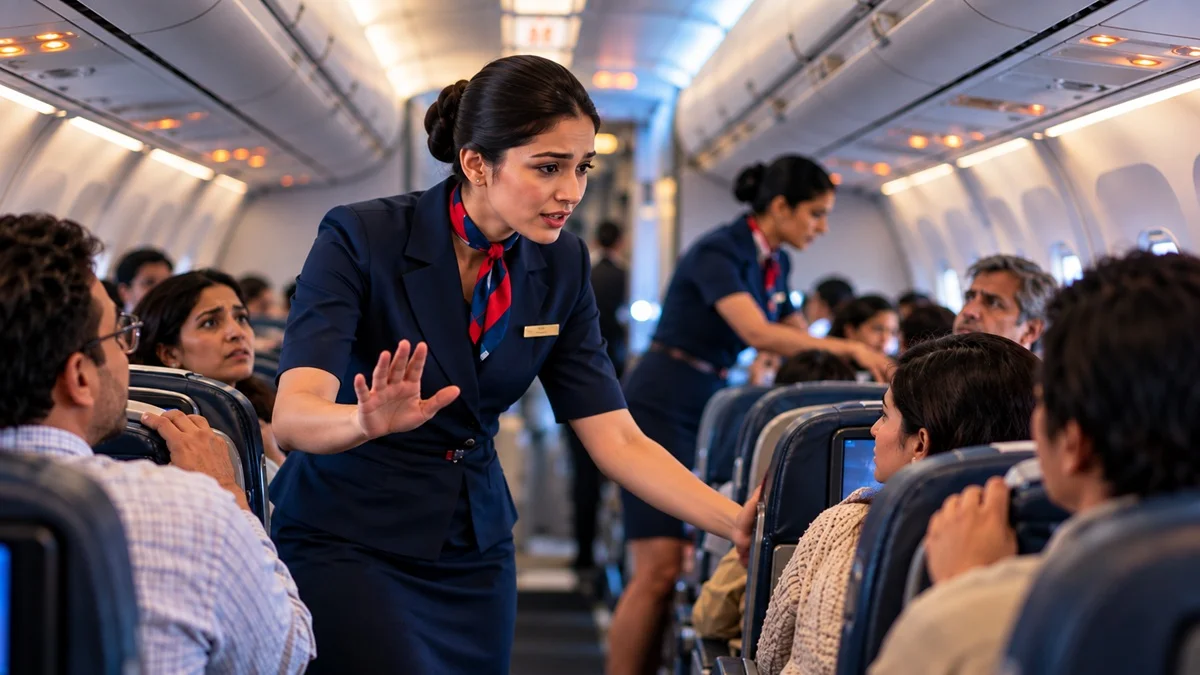
The Recent Flydubai Incident Raises an Important Question: Are Cabin Crews Prepared for the Human Side of Crisis?
On September 30, 2026, a Flydubai flight bound from Dubai to Tel Aviv dropped more than 14,000 feet in under half a minute. Inside the cabin, passengers who had been dozing or scrolling through their phones minutes earlier found themselves bracing for what many later said they believed was the end. A co-pilot had reportedly stabbed the captain and attempted to seize control of the aircraft. The captain, Indian national Smit Machchhar, fought back despite his injuries, managed to open the cockpit door, and a group of passengers and crew rushed in to subdue the attacker. The plane was diverted and landed safely at Tabuk Airport in Saudi Arabia.
Every account that’s emerged since describes the same thing: it wasn’t a rehearsed procedure that saved that flight. It was people — passengers who’d never met each other an hour earlier, crew members operating on instinct, a badly wounded pilot who kept fighting when he had every reason to stop. That detail is worth sitting with, because it points to a question the aviation industry doesn’t talk about nearly enough: when a crisis turns genuinely human and chaotic, rather than following the shape of a drilled-for scenario, how prepared is cabin crew really?
What Actually Happened Aboard Flight FZ1073
Based on reporting from multiple outlets, including CNN, NPR, and Axios, here’s what’s currently known. The incident occurred on Flydubai Flight FZ1073, a Boeing 737 travelling from Dubai to Tel Aviv. A co-pilot allegedly stabbed the captain and attempted to crash the aircraft, which went into a sharp descent before stabilizing. Despite being severely injured, Captain Machchhar managed to unlock the cockpit door, allowing passengers and remaining crew to enter and overpower the attacker. Israeli Prime Minister Benjamin Netanyahu described the episode as a prevented “9/11-type disaster,” while Israel’s Defense Minister characterized it as an attempted act of terrorism. Flydubai’s official statement referred more cautiously to an “altercation” on the flight deck, and both the airline and the UAE’s civil aviation authority have said the causes and circumstances remain under formal investigation.
The motive behind the attack is still unknown, and it’s worth being careful here — multiple outlets have noted that significant questions remain unanswered, and speculation ahead of the official investigation isn’t useful to anyone, least of all the people who were on that flight. What is consistently reported, though, is the sequence of events: an attack from within the flight deck, a severely wounded pilot who refused to give up, and a cabin full of strangers who organized themselves, under extreme duress, into the response that ultimately saved the flight.
Cockpit Security Was Built to Stop a Different Kind of Threat
To understand why this incident is prompting so much reassessment, it helps to understand what cockpit security was actually designed to do. After the September 11 attacks, airlines worldwide hardened cockpit doors specifically to prevent people from the cabin forcing their way into the flight deck. That change assumed the threat was always going to come from outside the cockpit — a hijacker from among the passengers, someone trying to breach a locked door from the cabin side.
What happened on FZ1073 was structurally different. The threat, according to reporting on the incident, originated from inside the cockpit itself — one crew member against another. A door hardened to keep outsiders from getting in does very little when the danger is already on the correct side of that door. And in this case, the very feature meant to protect the flight deck became, for a few critical seconds, the only thing standing between an injured captain and the help he needed from the cabin — help that only arrived because he was physically able to open that same reinforced door himself.
This is the kind of scenario that most existing crew security training wasn’t really built around. Current regulatory frameworks, including TSA-mandated recurrent training, cover self-defense and resistance against hijacking attempts, built on lessons learned after 9/11. That’s genuinely valuable preparation. But an insider threat from within the flight deck crew itself sits in a different category entirely, and it’s reasonable to ask whether existing training adequately addresses it.
The Technical Side of Crisis Training vs. the Human Side
Cabin crew training, broadly speaking, is extensive and genuinely rigorous when it comes to procedure. Evacuation drills, fire suppression, medical emergencies, decompression response, hijacking protocols — these are drilled repeatedly, tested, and refreshed on a recurring basis. None of that should be understated; it’s a large part of why commercial aviation remains as safe as it is.
What’s harder to train for, and what incidents like this one put into sharp focus, is everything that happens in the gap between a procedure and the actual human experience of a crisis unfolding in real time.
Managing Mass Panic Without a Script
Procedural training tells a crew member what steps to follow during an evacuation or a decompression event. It’s much less equipped to prepare someone for calming 150-plus frightened strangers, some of whom are convinced they’re about to die, while simultaneously processing their own fear and, in a scenario like FZ1073, potentially witnessing violence against a colleague. Passenger accounts from the flight describe screaming, repeated waves of turbulence, and moments where people genuinely believed the plane was going down. Keeping a cabin from tipping into full panic during something like that is as much an exercise in emotional regulation and communication as it is a procedural one.
Processing Trauma in Real Time, Mid-Task
A crew member in a crisis like this doesn’t get the luxury of processing what’s happening after the fact — they have to keep functioning, directing passengers, assessing injuries, and supporting an improvised response, all while the event is still actively unfolding around them. That’s an enormous psychological demand, and it’s not something a fire-extinguisher drill or an emergency slide deployment exercise prepares someone for.
Making Split-Second Decisions With No Precedent
Formal protocols exist for recognized categories of emergency. They don’t exist, by definition, for the specific, unprecedented combination of circumstances a crew might actually face. On FZ1073, it was reportedly on-duty crew and passengers working together, improvising in real time, who secured the aircraft — not a scripted response to a scenario anyone had specifically trained for. That’s not a criticism of the crew; if anything, it’s a testament to their instincts. But it does raise a fair question about how much of what kept that flight safe came from training, and how much came from sheer human resolve under conditions no training program fully anticipates.
What Happens to Crew After an Event Like This?
There’s a part of this conversation that gets even less attention than crisis training itself: what support exists for crew members once the immediate danger has passed.
Surviving a violent, traumatic event mid-flight doesn’t end when the aircraft lands safely. Crew members who respond to a crisis like this one are likely to carry the psychological weight of it well beyond the day it happened — and that’s true whether or not they were physically injured. The aviation industry has historically been better at supporting crew through the logistics of returning to work than through the slower, harder process of genuine psychological recovery.
It’s worth noting that this isn’t a new concern for the airline specifically. After flydubai flight FZ981 crashed in 2019, the global flight attendant community organized informally through social media to support one another, with crew members from unrelated airlines reaching out to share condolences and solidarity. That kind of peer support is genuinely valuable, but it also reflects a gap — when an industry’s crisis support leans heavily on informal, crew-organized solidarity rather than structured, guaranteed psychological care, something is missing from the formal system.
Worth asking directly: After an incident involving violence, serious injury, and the kind of fear passengers on FZ1073 described, what formal psychological debriefing, counseling access, and recovery time does a crew member receive as standard practice — not as a goodwill gesture, but as a guaranteed part of how the airline responds? That answer varies significantly across the industry, and it’s a genuinely fair thing for passengers, crew unions, and regulators to be asking right now.
The Debate This Incident Has Reignited
One concrete policy conversation that’s resurfaced directly because of this incident involves cockpit video recorders. Commercial aircraft are required to carry cockpit voice recorders, but not video recorders, and this incident has renewed a long-running debate over whether video would help investigators — and airlines — understand exactly how events like this unfold, rather than relying solely on audio and witness accounts after the fact.
That’s a meaningful conversation, but it’s worth noting it’s primarily about investigation and accountability after an event, not about how crew are actually prepared to handle the human chaos of an event while it’s happening. Both conversations matter, but they’re not the same one, and it would be a mistake to let the video recorder debate stand in for the deeper question about crisis training and psychological preparedness.
What Better Preparation Could Actually Look Like
None of this is meant to suggest crew members failed in any way on FZ1073 — by every account, they and the passengers around them responded with remarkable courage under circumstances nobody should have to face. The point is less about individual performance and more about whether the systems and training surrounding crew adequately prepare them for the full scope of what a real crisis can involve. A few areas worth genuine industry attention:
- Scenario-based psychological training, not just procedural drills — exercises that specifically simulate the emotional and communication demands of managing a frightened cabin, not just the physical steps of an evacuation.
- Insider-threat scenarios built into recurrent training, acknowledging that not every crisis originates from outside the flight deck.
- Crew Resource Management curricula that go further into human factors — stress response, communication under extreme duress, and decision-making when no existing protocol fits the situation.
- Guaranteed, structured post-incident psychological support, rather than informal peer solidarity standing in for genuine institutional care.
- Honest post-incident reviews that ask not just “what procedure was followed” but “what did the people involved actually need, and did they have it.”
Conclusion
What happened aboard Flydubai Flight FZ1073 will rightly be studied for its procedural and security lessons — how the attack happened, what the investigation uncovers about motive, and whether cockpit protocols need to change. Those are necessary conversations. But there’s a quieter, harder question sitting underneath all of it: when the moment came, it wasn’t a drilled procedure that saved that flight. It was an injured man who refused to stop fighting, and a cabin full of strangers who organized themselves into a response nobody had specifically trained them for.
That’s a remarkable thing to witness. It’s also, if the industry is honest with itself, a sign that the human side of crisis — the fear, the improvisation, the psychological toll on everyone involved, both during the event and long after it — deserves at least as much structured attention as the procedural side already receives. Better doors and better protocols matter. So does making sure the people counted on to respond in the worst moments are genuinely prepared, and genuinely supported, for what that actually asks of them.
Disclaimer: This article discusses an ongoing investigation into a real, serious incident. Details are based on publicly reported information available at the time of writing and may be updated or revised as official investigations proceed. This piece reflects general industry analysis and commentary, not confirmed findings of any investigating authority.