
Cabin Crew Career in 2026: Check Your Eligibility & Get Admission
Build a Career That Takes You Places, Literally!
Some careers come with a desk.
Some come with deadlines.
And some come with boarding passes.
A cabin crew career belongs to the third category.
A cabin crew career is for students who want movement, communication, confidence, travel, and a profession that feels alive every single day. And in 2026, the aviation industry is growing faster than ever. Airlines are expanding routes, airports are modernising rapidly, and passenger traffic across India continues to rise.
Which means one thing:
The demand for trained aviation professionals is rising too.
But here’s the important part — airlines today are not just looking for “good-looking candidates.” They are looking for professionals who can communicate confidently, manage people calmly, handle emergencies responsibly, and represent the airline with professionalism.
And that’s exactly where structured aviation training becomes important.
What Does a Cabin Crew Professional Actually Do?
Most people think cabin crew means serving meals onboard.
Reality? That’s probably the smallest part of the job.
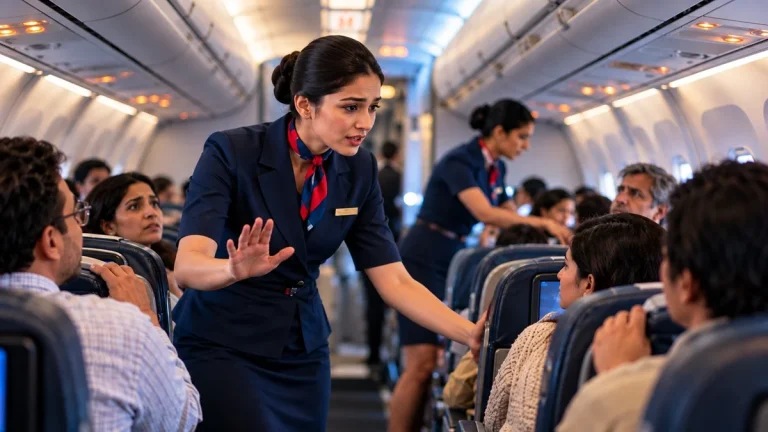
Cabin crew professionals have to ensure passenger safety. They are responsible for passengers’ smooth travel experience right from the take off to landing. The in-flight communication, emergency handling and hospitality are some of the responsibilities to look after as a cabin crew or air hostess. They assist passengers during boarding, then conduct safety demonstrations and respond quickly during medical or emergency situations.
In simple words:
They are the people who keep order, comfort and safety together inside an aircraft cabin.
And honestly, that takes far more skill than social media makes it look.
Why Aviation Is Becoming One of the Most Exciting Career Fields in 2026
The aviation industry is no longer a niche space. It is becoming one of India’s fastest-growing professional sectors.
With new airports, airline expansion, cargo growth, drone technology and rising domestic travel, aviation today offers opportunities far beyond just flying internationally. Students can now explore careers in:
- cabin crew,
- airport operations,
- airline customer service,
- aviation management,
- ground handling,
- hospitality,
- and even drone technology.
The aviation industry is expected to continue growing rapidly, creating strong demand for professionally trained manpower across departments.
And maybe that’s why aviation today feels less like a “dream job” and more like a serious future-ready career option.
Cabin Crew & Aviation Courses at Silver Oak University
At Silver Oak University, aviation education is offered through the Silver Oak College of Aviation Technology (SOCAT) — a DGCA-approved constituent college focused on specialised aviation training.
The university offers industry-oriented programmes such as:
- Cabin Crew & Airport Management,
- BBA Aviation Management,
- MBA Aviation Management,
- Aircraft Maintenance Engineering (AME),
- and DGCA-approved drone training programmes.
What makes the training feel different is that the focus goes beyond classroom theory. Students are trained in:
- passenger handling,
- aviation hospitality,
- grooming,
- airport operations,
- communication skills,
- safety procedures,
- and personality development.
Because aviation industries don’t simply recruit graduates anymore.
They recruit industry-ready personalities.
Real Aviation Exposure — Not Just Classroom Learning
This is where things start becoming genuinely exciting.
SOCAT provides students with aviation-focused infrastructure including:
- mock airport setups,
- mock cabin training,
- aircraft exposure,
- advanced aviation labs,
- and practical learning environments designed to simulate real industry settings.
The college also has training collaborations with Indamer Technics Pvt. Ltd., helping students gain industry exposure aligned with aviation standards and real aircraft environments.
Which means students are not just learning aviation theoretically.
They’re experiencing aviation environments while studying.
That changes confidence completely.
Course Duration
Most cabin crew and airport management training programmes are designed to help students become professionally ready within a shorter duration compared to many traditional degree routes.
Depending on the programme structure, aviation training may range from certificate-level durations to full-fledged degree programmes like BBA Aviation Management.
And for students who want quicker industry exposure, that matters a lot.
Are You Eligible?
Students who have completed 10+2 or diploma qualifications from recognised boards are generally eligible for Cabin Crew & Airport Management programmes at SOCAT.
The typical eligibility criteria include:
- Age between 17–24 years,
- minimum height requirements,
- basic fluency in English and Hindi,
- and a professional, well-groomed personality.
The university also focuses strongly on communication, confidence-building, personality grooming, and professional etiquette because these are the qualities airlines genuinely value during recruitment.
And no — students from only one stream are not preferred.
Science, Commerce, Humanities — aviation welcomes confidence from everywhere.
Why Communication Skills Matter So Much in Aviation
Cabin crew professionals interact with hundreds of passengers every day. Some are anxious travellers. Some are elderly passengers needing assistance. Some are travelling internationally for the first time.
This is why communication becomes one of the biggest skills in aviation.
At Silver Oak University, aviation training focuses not only on technical understanding but also on:
- spoken communication,
- body language,
- personality enhancement,
- customer interaction,
- and professional confidence.
Because in aviation, the way you communicate often matters as much as what you say.
What Students Learn During Cabin Crew Training
The training curriculum is designed around real airline responsibilities. Students are trained in:
- aviation safety,
- emergency handling,
- first aid,
- customer service,
- in-flight communication,
- grooming standards,
- and airline etiquette.
Training also includes learning about safety equipment such as oxygen masks, emergency exits, and evacuation procedures.
Because when situations become stressful onboard, cabin crew professionals are expected to stay calm before everyone else does.
Career Opportunities After Aviation Training
After completing aviation programmes from SOCAT, students can explore opportunities in:
- cabin crew,
- airline customer service,
- airport ground operations,
- passenger handling,
- guest relations,
- airport hospitality,
- baggage and cargo handling,
- and airline operations.
The university also highlights career support, placement assistance, industrial exposure, and recruiter connections across aviation sectors.
And perhaps the biggest advantage of aviation careers is this:
they rarely feel routine.
Your workplace, schedule, people, and experiences constantly evolve.
Why Students Are Choosing Aviation at Silver Oak University
Students today don’t just want degrees anymore.
They want:
- industry exposure,
- practical learning,
- confidence,
- placements,
- and careers that actually feel future-focused.
And that’s exactly why aviation education at Silver Oak University feels aligned with modern student aspirations. There are aviation labs, there is a mock airport setup and also DGCA-approved infrastructure. The university has industry collaborations to make sure that the focus stays strongly on preparing students for the real aviation world just after they step out.
Final Thought
Beside the glamour wrapped in a uniform, the cabin crew career is mainly about giving a smooth flight experience to the passengers. Aviation used to be just an exciting industry before. Now, it is becoming one of the most dynamic career spaces for students who want global exposure, personality growth, professional confidence and fast-moving opportunities. And maybe that’s why more students today are not just dreaming about flying anymore. They’re preparing to build careers above the clouds.